Detection of Ruthenium 106 in the air in the East and South-East parts of Europe

Since late September 2017, Ruthenium 106 has been detected by several European networks involved in the monitoring of atmospheric radioactive contamination. Ruthenium 106 is a radionuclide of artificial origin. It is a fission product from the nuclear industry. This radionuclide is also used in the medical field for brachytherapy treatments.

The very low levels of atmospheric contamination of Ruthenium 106 observed to date by European monitoring networks have no environmental or health consequences in monitored countries. Nevertheless, all European networks maintain a watchful vigilance on this presence of ruthenium in the air.

For further details, you can find information on the websites of our NERIS supporting organisations:

Memorandum of Understanding between Nugenia and the 4 European Research Platforms

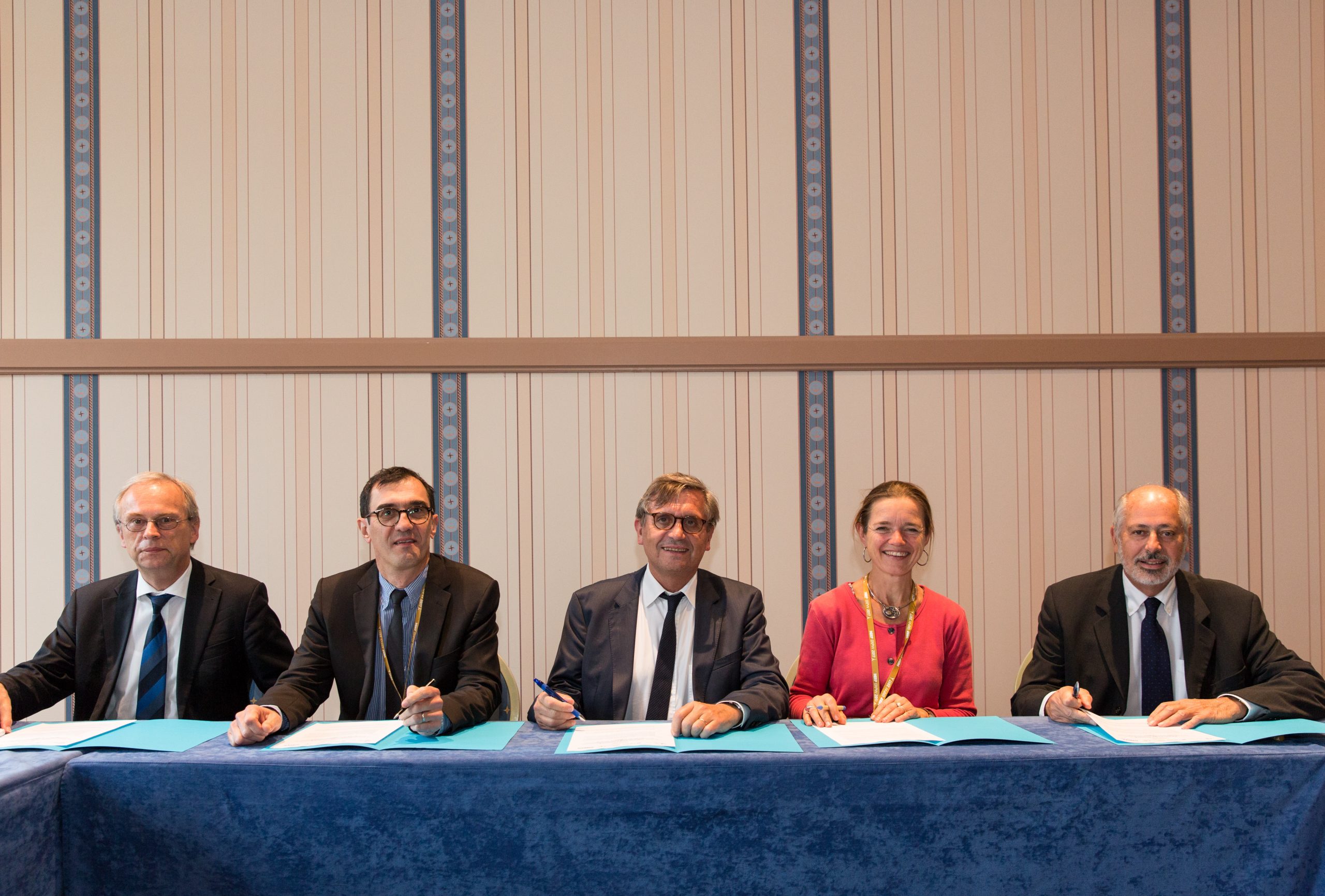
171010signature001

On October 10, 2017 the 4 European Research Platforms ALLIANCE, EURADOS, MELODI and NERIS have signed a Memorandum of Understanding (MoU) with the NUGENIA community which is dedicated to advance the safe, reliable and efficient operation of nuclear power plants. This MoU provides a framework for close cooperation between NUGENIA and the 4 research Platforms for the promotion of radiation protection research in Europe.

This ceremony took place during the last ERPW17 in Marne-la-Vallée (France).

TERRITORIES Workshops in Oslo – 14-16 November 2017

Within Work Package 4 (Strategic and integrated communication, education and training) of the TERRITORIES (To Enhance unceRtainties Reduction and stakeholders Involvement TOwards integrated and graded Risk management of humans and wildlife In long-lasting radiological Exposure Situations) project, one of the objectives is to identify and communicate to appropriate audiences the existing capabilities, key uncertainties, needs and knowledge gaps in radiological risk assessment and management for humans and wildlife in long-lasting radiological exposure situations. To reach this objective, a number of workshops will be organised through the 3 years of the project.  The TERRITORIES project has received funding from the Euratom research and training programme 2014-2018 in the framework of the CONCERT EJP [grant agreement No 662287].

 In 2017, two workshops will be organised:

  • Workshop one: Key factors contributing to uncertainties in radiological risk assessment, which objective is to discuss the key factors contributing to overall uncertainties when linking deposition and ecosystem transfer to human and ecosystem radiological risk assessment models, obtaining feedback from modellers, experimentalists and stakeholders on this subject.
    Download the agenda here

  • Workshop two:Communication of uncertainties of radiological risk assessments to stakeholders, which objective is to discuss the implications and relevance of uncertainties in radiological risk assessments for different stakeholders and how these uncertainties can be better communicated, obtaining feedback from regulators, industry, scientists and “public/social sciences” on this subject.
    Download the agenda here

Both workshops will be held in Oslo, Norway, November 14-16th 2017. Since both workshops are strongly connected, people are encouraged to participate in both of them.

Please fill out the  registration form by email to mirian.wangen@nmbu.no before September 29th 2017.

Consultation meeting on the NERIS Roadmap

concert

In the framework of CONCERT WP2, NERIS, as other European research platforms, has the commitment to prepare its roadmap with a long-term view and aiming to identify research priorities in emergency and recovery issues. This roadmap will also contribute to explore joint interests for multidisciplinary and synergistic research between all Platforms.

To elaborate the roadmap, CONCERT WP2 proposed to each platform to work on different scenarios to be discussed afterward with all other platforms. In this way, NERIS has been working on two different scenarios:

  • Facing the consequences of a nuclear or radiological major accident or incident: how to optimize society’s preparedness, and short term/long term response?
  • Facing the threat of a radiological terrorist act: How to minimize consequences?

Based on these scenarios (enclosed to the invitation email), a first draft of the NERIS roadmap has been elaborated and tries to highlight some topics of the updated NERIS SRA challenges.

Thus, the overall objective of this consultation meeting is to discuss among the NERIS community about this NERIS roadmap and to collect the comments and proposals. Based on these discussions a consolidated NERIS Roadmap will be prepared by the end of November 2017.

Please note that this meeting is devoted to discuss the long-term vision of NERIS in terms of research in the key areas identified in the SRA and as presented in the Roadmap document sent out in July. This vision has to be subdivided into “realistic” steps to reach this goal which is expressed in intermediate research endpoints after 5 and 10 years from now. This discussion should not focus on possible funding but concentrate on the scientific and societal challenges in the different areas.

For further information, please download the agenda of the meeting.

For registration, please complete the appropriate form and returne it to the NERIS Secretariat (sec@eu-neris.net)
Researchers from 11 Countries Agree on New Recommendations to Deal with Possible Nuclear Accidents

AAFF DEF SHAMISEN ENG

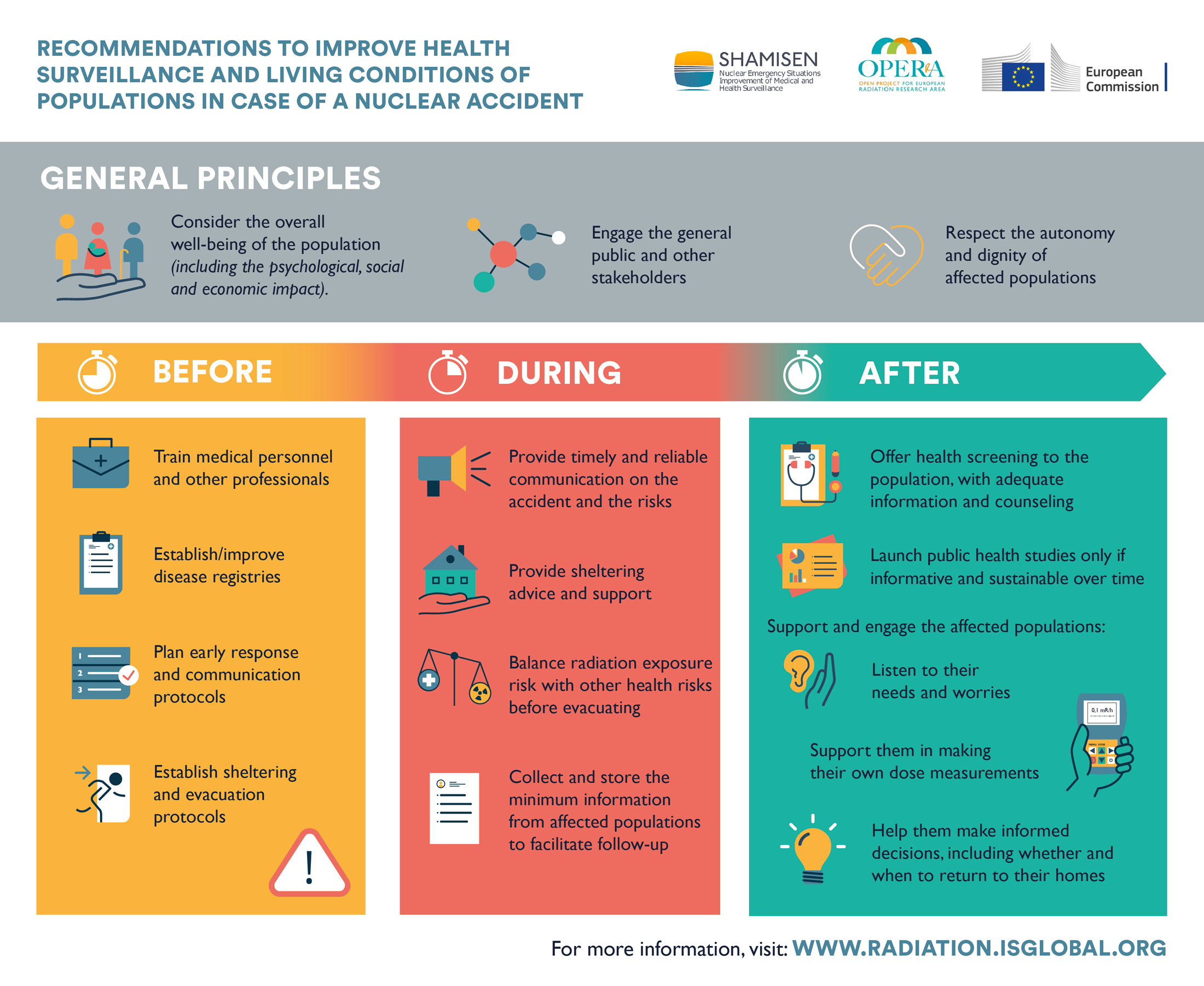
In the unlikely but not impossible case of a future nuclear accident, what should be done – or not –  to improve the health surveillance and living conditions of affected populations without generating collateral damage or unnecessary anxiety? This is what the EC-funded project SHAMISEN has tried to address over the last 18 months with an analysis of lessons learned from Chernobyl and Fukushima. The result is a document with 28 recommendations to improve the preparedness and response to a radiation accident, including for each recommendation a ‘why’ (based on lessons learned) a ‘how’, and a ‘who’ (those responsible of implementing the recommendation).

The document highlights the importance of planning the response “in times of peace” and includes recommendations to improve training of professionals, establish disease registries to know whether these diseases increase after the accident, and establish evacuation protocols and routes if necessary. Recommendations ‘during’ the response include providing timely and reliable information on the accident situation and associated risks, and ensuring collection of radiation dose data. For the ‘after’, the main recommendations include establishing a dialogue between experts and affected communities with the help of local facilitators, and providing support to populations that wish to make their own dose measurements so they can take informed decisions (e.g. what food they eat or if and when they return to their homes).  Recommendations also include providing health screening of populations on a voluntary basis and with adequate counselling to avoid unnecessary anxiety, and launching long-term public health studies only when informative and sustainable over time. All recommendations were developed taking into consideration the cross-cutting issue of ethics and the involvement of local stakeholders, including the population.

For more Information:

Radioprotection revue, Vol. 51 (December 2016) – HS2

The outcomes of the PREPARE European project have been published in a supplemental issue (Vol. 51, HS2) of the Radioprotection revue:
Innovative integrated tools and platforms for radiological emergency preparedness and post-accident response in Europe. Key results of the PREPARE European research project.

Editors: Tatiana Duranova, Wolfgang Raskob and Thierry Schneider

You will find the Table of contents and all articles on this page.

NERIS Newsletter 12th issue

The 12th issue of the NERIS Newsletter is now available. This edition is dedicated to the NERIS contribution during the Radiation Protection Week 2016.

NERIS Newsletter 13th issue

   The 13th issue of the NERIS Newsletter is now available.
   This edition is dedicated to the new european research projects CONFIDENCE & TERRITORIES as well as the final SHAMISEN Workshop,
   held in Paris last March.

17th EAN Workshop (in collaboration with NERIS), Lisbon, Portugal – 15 – 17 May 2017

15-17 May 2017

Emergency exposure situations can arise as a result of a nuclear accident, a malicious or terrorist act, or any other unexpected radiological event. It requires a quick response and sustainable countermeasures and remedial actions in order to avoid or reduce adverse short-term and long-term consequences. Radiation exposures can be received by the public, first responders, workers and volunteers engaged in the post-accident recovery.

The ICRP recommendations and European Basic Safety Standards – the bases for national regulations – re-emphasize the principle of optimisation (ALARA) as applying to emergency exposure situations. For the purpose of radiological protection, reference levels for emergency exposure situations should be set. More importantly, it is necessary to establish emergency plans based on an optimum protection strategy, resulting in more good than harm for the exposed people and the affected territories. In that perspective, lessons learnt from the Fukushima accident are of utmost importance.

 The objectives of the workshop are:

  • To show, in particular from the experience of Fukushima accident, the challenges posed by the optimisation of exposures in emergency and post-accident situations;
  • To review the national arrangements for assessing, monitoring and mitigating the radiological consequences of an emergency, especially with regard to applying the ALARA principle to public and occupational exposures;
  • To review the arrangements for managing emergency doses to workers;
  • To review the arrangements for providing ALARA-based training for the different types of stakeholders who would be engaged in the emergency response and long-term recovery actions.

The workshop will consist of presentations (oral and posters) intended to highlight the main issues, and a significant part of the program will be devoted to discussions within working groups. From these discussions, participants will be expected to produce recommendations on ALARA in emergency exposure situations, which are addressed to relevant local, national and international stakeholders.

For further information, please visit the EAN Website.

ICRP 2017 & ERPW 2017 – 10-12 October 2017

10 – 12 October 2017 ICRP 2017 Announcement small


4th International Symposium of the System of Radiological Protection in conjonction with the European Radiological Protection Research Week are being organized in Paris from 10 to 12 October 2017.

This combined event will offer the opportunity for professionals, experts and researchers worldwide to discuss their respective concerns and the current challenges faced in all areas of radiological protection, as well as the ways
forward through new research, updating doctrines, or better interactions with stakeholders.

The programme schedule of the ICRP-ERPW2017 conferences is now available. You can download it here.

We remind yout that registration to ICRP-ERPW 2017 is still opened at http://www.icrp-erpw2017.com.
Please note that the registration fees will increasr from Sunday 1st October 2017.

Web page: http://www.icrp-erpw2017.com